Why Are Stairs So Painful with Knee Osteoarthritis?
If stairs have become your enemy, you’re not imagining it. Climbing and descending stairs is one of the most demanding things we ask of our knees, and it’s often the first activity osteoarthritis (OA) makes difficult.
Why stairs hurt
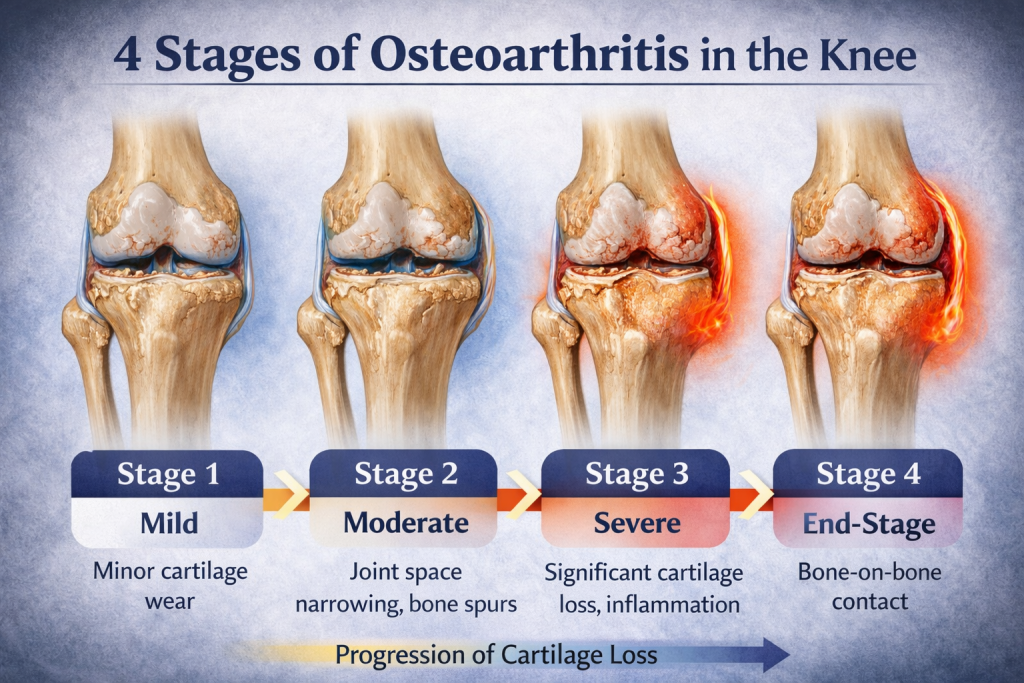
Each step up or down loads the knee with several times your body weight. In a healthy knee, smooth cartilage and lubricating joint fluid absorb that force. With OA, the cartilage thins and roughens, the joint fluid loses some of its cushioning quality, and the surrounding tissue becomes irritated and inflamed. The image below shows how knee osteoarthritis progresses from Stage 1 – Mild to Stage 2- Moderate to Stage 3 – Severe and Stage 4 – End-Stage. OA in untreated knee degenerates faster than a knee that regularly receives treatments to slow the arthritis progression. The bending and loading of stair climbing puts pressure on exactly those worn surfaces. Going downstairs is often worse, because the muscles must control your body weight as the knee bends, which creates even more force through the joint.
Schedule an appointment
If pain or injury is affecting your life, don’t wait for it to get worse. Our team at Virginia Orthopedics and Sports Medicine in Fairfax, VA is here to help you get back on the court. Call us at (703) 646-1270 to schedule an evaluation.
Stephanie Singh, DO, is a board-certified orthopedic and sports medicine physician at Virginia Orthopedics and Sports Medicine.
- Physical Evaluation
- In-office Ultrasound
- Joint Injection
- Regenerative Medicine
- Physical Therapy
Finding the cause with in-office ultrasound
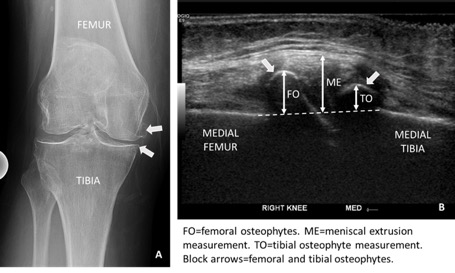
Knee pain on stairs isn’t always from OA alone. Real-time musculoskeletal ultrasound lets us look at the knee during your visit, with no waiting and no radiation. We can assess:
- Cartilage thinning and bone spurs
- Fluid or inflammation within the joint
- Tendons, ligaments, and the meniscus
- How the joint responds as we move the knee
Seeing what is actually happening inside your knee lets us tailor a treatment plan to you.
Treatment options
Many people with knee OA can stay active and keep taking the stairs comfortably with the right plan. Options include:
- Exercise rehabilitation to strengthen the muscles that support and protect the knee
- Hyaluronic acid injections, which supplement the joint’s natural lubricating fluid to improve cushioning and ease movement
- Platelet-rich plasma (PRP) injections, which use concentrated platelets from your own blood to calm inflammation and support the joint environment
The best option depends on how advanced your OA is and what you want to get back to doing.
Don’t wait for the pain to get worse. Early evaluation and ongoing management can help prevent flare-ups and keep you moving.
Joint health importance and improvement should be part of our daily regiment
Ways to improve bone and joint health include a diet rich in fresh fruits and vegetables. Leafy greens are especially rich in calcium and other minerals that can help both your joints and bones. If you exercise, be sure to choose low impact exercises that do not place too much strain on your joints. Many people choose walking, cycling or swimming to stay in shape. Yoga and gentle stretching can help keep your joints more flexible, too. Lifting small weights can also improve your bone density.
Exercise also improves mood, reduces stress and boosts your immune system. The best time to fight osteoporosis is before it begins. Bone and joint health are a part of your overall wellness. You should also talk to your doctor, as certain medications (even over the counter ones), can leech calcium from your bones.
If you or your loved ones are experiencing joint or other musculoskeletal pain contact us for diagnosis, treatment, and future prevention.
3998 Fair Ridge Dr., Suite 125
Fairfax, VA 22030
703-646-1270
Hours:
Monday - Friday
8am - 4pm